


Fingertips
Easily access helpful, in-depth information on all things concrete construction—right at your fingertips.
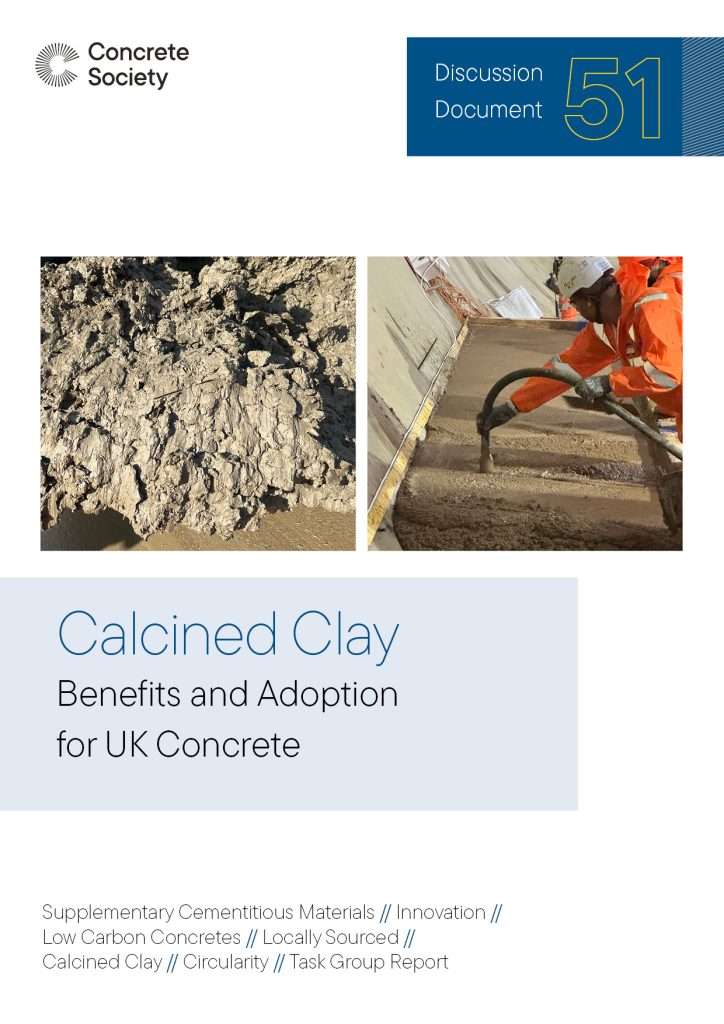
Discussion Document 51: Calcined Clay
This discussion document aims to demonstrate the viability of calcined clays as a Supplementary Cementitious Material (SCM) in concrete, addressing concerns over its techno-economic feasibility and challenging current perceptions.
The paper recommends a series of interventions to enable behavioural change, demand signalling, and widespread adoption of calcined clay in the UK. These outcomes were facilitated by the Calcined Clay Task and Finish Group.
The UK construction industry faces significant challenges in the procurement and control of emissions for cementitious materials in concrete. With rising demand for cement and increased production costs, there is a net deficit of UK production and a decline in some SCMs, which will increase the cost of supply and reduce resource security.
Calcined clay presents a viable alternative, offering a cost-effective, sustainable solution for UK concrete construction. Calcination is 40% more efficient than CEM I and eligible for up to 55% replacement under British and European standards, achieving 35% less embodied carbon while improving resource security.
Despite its benefits, calcined clay has not been widely implemented in the UK due to a complex system of interconnected barriers. These barriers include informational, techno-economic, cultural, organisational, and regulatory challenges, creating a supply-demand deadlock.
Calcined clay has the potential to form part of the next generation of lower carbon cementitious materials for concrete. However, without sufficient infrastructure and industry commitment, its contribution to carbon reduction targets will not be realised. The recommended strategy and mitigations aim to overcome the barriers to adoption and enable the widespread use of calcined clay in the UK, contributing significantly to the UK’s Net Zero journey.
This discussion document is published by the Concrete Society on behalf of a Task and Finish Group led by:
- Charlotte Hills, Head of Innovation, HS2
- Jon Knights Lead, Materials & Durability, HS2
- Marta de Miguel, Programme Manager, MTC
- Joanna Starkie, Sustainable Materials Specialist, PA Consulting
- Pete Winslow, Director, Expedition Engineering
- Amy Woodward, Sustainability and Innovation Specialist, PA Consulting
The document is to be launched on 4 December 2025
Please click here to download your free version.

Related Publications


Become a Member

The Concrete Society is here to guide and support you every step of the way
- Technical resources and expert guidance
- Industry news and leading magazines
- An Independent team of in-house Technical Advisors
- Join a vibrant community from across the concrete supply chain