
For sole traders, students and anyone interested in concrete.
Fingertips
Easily access helpful, in-depth information on all things concrete construction—right at your fingertips.
Field not found.
Found 1003 Results
Page 1 of 112
Page 1 of 112
Page 1 of 112
Discussion Document 51: Calcined Clay
This discussion document aims to demonstrate the viability of calcined clays as a Supplementary Cementitious Material (SCM) in concrete. The paper recommends a series of interventions to enable behavioural change, demand signalling, and widespread adoption of calcined clay in the UK.

3 December 2025
Surface finish specification
There are many concrete surface finish specifications that can be specified, for example
3 June 2025
Hot weather concreting
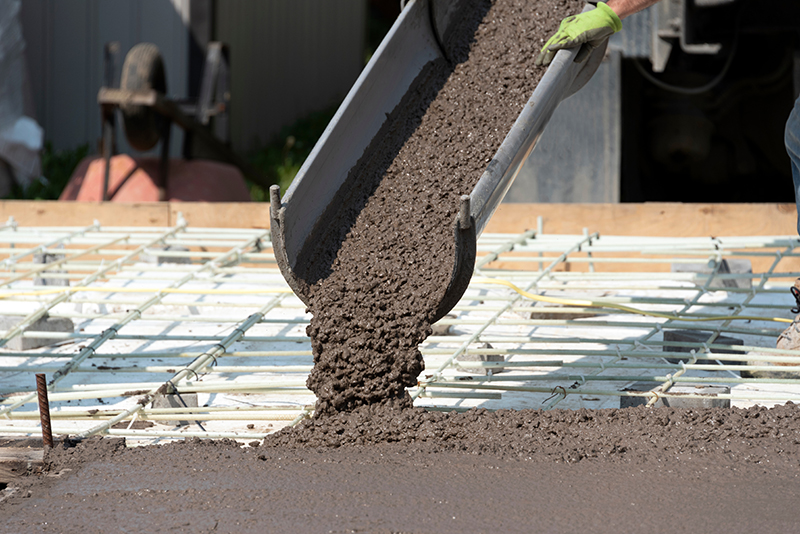
Hot weather concreteing. Higher temperatures for the fresh concrete will lead to more rapid hydration and higher early age maximum temperatures.
<a href="https://www.concrete.org.uk/tag/featured/" rel="tag">Featured</a>
3 June 2025
Cover to reinforcement
In nearly all instances, cracks develop at the surface of concrete and are restrained by the tensile reinforcement. If a good bond exists between the concrete and the steel, the width of the crack at the steel will be very small.

3 June 2025
Void formers
The formation of openings in concrete, either to reduce the weight of the structure or to provide access for services, calls for particular attention in the selection of the former material, positioning and subsequent withdrawal if required.

3 June 2025
Direct measurement of concrete permeability by flow
For the direct measurement of the permeability of concrete by the flow method, a test cell is required that is similar, in principle, to the modified triaxial cells used in standard soil and rock mechanics tests.

3 June 2025
Depth of water penetration under pressure
For dense and, hence, low permeability concrete, the depth of penetration method is usually a more practical proposition than permeability flow tests.

3 June 2025
Rapid migration test
There are indications that this test is less variable than the Rapid Chloride Permeability testing RCPT and unaffected by different cementitious materials and conductive admixtures.

3 June 2025
Electrical Current Flow or Rapid Chloride Permeability Test (RCPT)
This method is described in AASHTO T 277–831 'Rapid Determination of the Chloride Permeability of Concrete' and ASTM C1202.
3 June 2025
Featured Fingertips
Hot weather concreteing. Higher temperatures for the fresh concrete will lead to more rapid hydration and higher early age maximum temperatures.
Delamination is characterised by thin layers of surface mortar becoming detached from the main body of the slab. Concrete Advice Sheet 18 provides an overview of the causes of delamination in concrete floors.

Cold joints are formed primarily between two batches of concrete where the delivery and placement of the second batch has been delayed and the initial placed and compacted concrete has started to set. The full knitting together of the two batches of concrete under vibration to form a homogeneous mass is therefore not possible, unlike the compaction of two fresh workable batches of concrete. This could be a potential plane of weakness.

Prior to the introduction of power tools, a floated finish was that produced by a large, generally wooden or sometimes metal, hand float moved over the surface when the concrete was still plastic. This produced a flattish slightly textured surface which often contained float marks. Nowadays, the operation is carried out using powered machines fitted with either a large circular pan or large flat metal floats. Power floating is generally carried out later than hand floating as the concrete needs to take the weight of the machine. A simple test is when the heal of a boot leaves only a slight impression, say 3mm. Power-floating produces a similar surface to hand floating, with a slightly textured surface often with circular swirl marks from the floating operation. This operation is sometimes called panning.

Our top 10 most visited Fingertips
Aggregate blocks come in two types.

Cold joints are formed primarily between two batches of concrete where the delivery and placement of the second batch has been delayed and the initial placed and compacted concrete has started to set. The full knitting together of the two batches of concrete under vibration to form a homogeneous mass is therefore not possible, unlike the compaction of two fresh workable batches of concrete. This could be a potential plane of weakness.

Consistence, measured using the slump test (BS EN 12350-2), is either specified as a class or target. Although a supplier will endeavour to provide the required value or range, deviations in production and sampling apply. The following tables give the maximum allowable deviation based on a spot sample taken from the initial discharge of a ready-mixed concrete truck.

Prior to the introduction of power tools, a floated finish was that produced by a large, generally wooden or sometimes metal, hand float moved over the surface when the concrete was still plastic. This produced a flattish slightly textured surface which often contained float marks. Nowadays, the operation is carried out using powered machines fitted with either a large circular pan or large flat metal floats. Power floating is generally carried out later than hand floating as the concrete needs to take the weight of the machine. A simple test is when the heal of a boot leaves only a slight impression, say 3mm. Power-floating produces a similar surface to hand floating, with a slightly textured surface often with circular swirl marks from the floating operation. This operation is sometimes called panning.

Retarding admixtures have little or no effect other than to delay the setting of the cement. They do not plasticise significantly and have no effect on the water demand or other properties of the concrete. Retarding plasticising admixtures not only delay the setting of the cement but are also efficient plasticising water-reducers. Most commercially available retarders are of this type. Retarding plasticisers are used to give workability retention to the concrete, delay the setting time and increase initial workability.

The slump test is a means of assessing the consistency of fresh concrete. It is used, indirectly, as a means of checking that the correct amount of water has been added to the mix. The test is carried out in accordance with BS EN 12350-2, Testing fresh concrete. Slump test. 

Fingertips Easily access helpful, in-depth information on all things concrete construction—right at your fingertips. Back to all fingertips Core testing for compressive strength When required, cores are cut using a drill with a hollow barrel tipped with industrial diamonds. The whole rig has to be firmly fixed in position by weights, anchor bolts, vacuum pads [...]

Honeycombing is the term used to describe areas of the surface that are coarse and stony. It may be caused by insufficient fine material in the mix, perhaps due to incorrect aggregate grading or poor mixing. This can be corrected by increasing the sand and cement content of the mix and by proper mixing, placing and compaction. Alternatively, honeycombing may be caused by leakage of grout or mortar fraction from the concrete at construction or formwork joints. The obvious solution here is to ensure that joints are well sealed and leak-free.
There is often debate about the time limit between placing fresh concrete against fresh concrete already placed and compacted i.e. minimising the risk of a cold joint being formed.
A suspended concrete floor is a floor slab where its perimeter is, or at least two of its opposite edges are, supported on walls, beams or columns that carry its self weight and imposed loading. The floor spans between supports and will normally deflect under load to a dimension that is limited by the design used. The prestressing of a concrete floor slab can eliminate its usual deflection below support level. This is achieved either by pre-tensioning, where precast floor units are used, or by post tensioning with steel wire tendons incorporated in an in-situ concrete slab.
Featured Fingertips
Hot weather concreteing. Higher temperatures for the fresh concrete will lead to more rapid hydration and higher early age maximum temperatures.
Delamination is characterised by thin layers of surface mortar becoming detached from the main body of the slab. Concrete Advice Sheet 18 provides an overview of the causes of delamination in concrete floors.
Cold joints are formed primarily between two batches of concrete where the delivery and placement of the second batch has been delayed and the initial placed and compacted concrete has started to set. The full knitting together of the two batches of concrete under vibration to form a homogeneous mass is therefore not possible, unlike the compaction of two fresh workable batches of concrete. This could be a potential plane of weakness.
Prior to the introduction of power tools, a floated finish was that produced by a large, generally wooden or sometimes metal, hand float moved over the surface when the concrete was still plastic. This produced a flattish slightly textured surface which often contained float marks. Nowadays, the operation is carried out using powered machines fitted with either a large circular pan or large flat metal floats. Power floating is generally carried out later than hand floating as the concrete needs to take the weight of the machine. A simple test is when the heal of a boot leaves only a slight impression, say 3mm. Power-floating produces a similar surface to hand floating, with a slightly textured surface often with circular swirl marks from the floating operation. This operation is sometimes called panning.
Latest Fingertips

This discussion document aims to demonstrate the viability of calcined clays as a Supplementary Cementitious Material (SCM) in concrete. The paper recommends a series of interventions to enable behavioural change, demand signalling, and widespread adoption of calcined clay in the UK.
There are many concrete surface finish specifications that can be specified, for example

Hot weather concreteing. Higher temperatures for the fresh concrete will lead to more rapid hydration and higher early age maximum temperatures.

In nearly all instances, cracks develop at the surface of concrete and are restrained by the tensile reinforcement. If a good bond exists between the concrete and the steel, the width of the crack at the steel will be very small.

The formation of openings in concrete, either to reduce the weight of the structure or to provide access for services, calls for particular attention in the selection of the former material, positioning and subsequent withdrawal if required.

For the direct measurement of the permeability of concrete by the flow method, a test cell is required that is similar, in principle, to the modified triaxial cells used in standard soil and rock mechanics tests.

For dense and, hence, low permeability concrete, the depth of penetration method is usually a more practical proposition than permeability flow tests.

There are indications that this test is less variable than the Rapid Chloride Permeability testing RCPT and unaffected by different cementitious materials and conductive admixtures.
This method is described in AASHTO T 277–831 ‘Rapid Determination of the Chloride Permeability of Concrete’ and ASTM C1202.
Featured Fingertips
Hot weather concreteing. Higher temperatures for the fresh concrete will lead to more rapid hydration and higher early age maximum temperatures.
Delamination is characterised by thin layers of surface mortar becoming detached from the main body of the slab. Concrete Advice Sheet 18 provides an overview of the causes of delamination in concrete floors.
Cold joints are formed primarily between two batches of concrete where the delivery and placement of the second batch has been delayed and the initial placed and compacted concrete has started to set. The full knitting together of the two batches of concrete under vibration to form a homogeneous mass is therefore not possible, unlike the compaction of two fresh workable batches of concrete. This could be a potential plane of weakness.
Prior to the introduction of power tools, a floated finish was that produced by a large, generally wooden or sometimes metal, hand float moved over the surface when the concrete was still plastic. This produced a flattish slightly textured surface which often contained float marks. Nowadays, the operation is carried out using powered machines fitted with either a large circular pan or large flat metal floats. Power floating is generally carried out later than hand floating as the concrete needs to take the weight of the machine. A simple test is when the heal of a boot leaves only a slight impression, say 3mm. Power-floating produces a similar surface to hand floating, with a slightly textured surface often with circular swirl marks from the floating operation. This operation is sometimes called panning.
Consistence, measured using the slump test (BS EN 12350-2), is either specified as a class or target. Although a supplier will endeavour to provide the required value or range, deviations in production and sampling apply. The following tables give the maximum allowable deviation based on a spot sample taken from the initial discharge of a ready-mixed concrete truck.

Carbonation is the reaction of carbon dioxide in the environment with the calcium hydroxide in the cement paste. This reaction produces calcium carbonate and lowers the pH to around 9.

The slump test is a means of assessing the consistency of fresh concrete. It is used, indirectly, as a means of checking that the correct amount of water has been added to the mix. The test is carried out in accordance with BS EN 12350-2, Testing fresh concrete. Slump test. 

The following Table gives the compressive strengths (based on cylinders and cubes), modulus of elasticity and tensile strength for various strength classes of normal weight concrete. They are taken from Table 3.1 of the Eurocode 2, which gives additional properties as well as values for other strength classes. It should be notes that these are characteristic values and should be modified as appropriate for design purposes.

Honeycombing is the term used to describe areas of the surface that are coarse and stony. It may be caused by insufficient fine material in the mix, perhaps due to incorrect aggregate grading or poor mixing. This can be corrected by increasing the sand and cement content of the mix and by proper mixing, placing and compaction. Alternatively, honeycombing may be caused by leakage of grout or mortar fraction from the concrete at construction or formwork joints. The obvious solution here is to ensure that joints are well sealed and leak-free.

