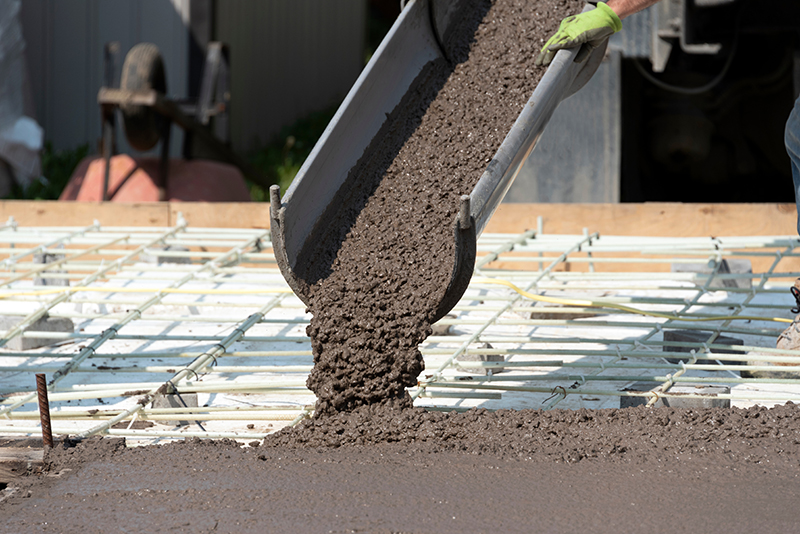
Hot weather concreting
Hot weather concreteing. Higher temperatures for the fresh concrete will lead to more rapid hydration and higher early age maximum temperatures.

Hot weather concreteing. Higher temperatures for the fresh concrete will lead to more rapid hydration and higher early age maximum temperatures.
Superabsorbent Polymers (SAPs) can act as internal curing agents in concrete. They absorb and store much more water than their own weight and form a system of evenly distributed water-filled cavities in the hardened cement paste. The concept has been explored for over 20 years but there are currently no commercially available systems for concrete.
The trend for recycling of municipal refuse in the UK has led to the construction of a significant number of new domestic waste transfer facilities. In many of these facilities the domestic waste is tipped directly on to concrete floors from refuse collection vehicles and then handled by loading shovels. It has been observed that some of these concrete floors have experienced extremely high levels of abrasion resulting in a rapid surface loss. Wear rates in excess of 25mm in one year have been reported. Floors experience lower levels of abrasion where waste is tipped directly into a waste bunker and is then handled by grab crane.
Concrete geothermal piles are structural concrete piles which incorporate pipework for a geothermal heat exchange system.
The most common application for composite slabs on steel decking is in steel framed buildings. Composite slabs are generally a quick and economical form of construction, but there are aspects of their design, construction and performance that need to be considered carefully if problems in construction are to be avoided. There had been a number of cases of decking bending and collapsing during concreting, and in a few of these cases operatives had fallen through the resultant opening. Guidance on aspects of the construction of composite slabs is given in Concrete Society Technical Report 75, Composite concrete slabs with steel decking.
Composite slabs on steel decking are widely used in steel framed buildings as they provide a quick and economical form of construction. However, care should be taken when the slabs are cast during cold weather

Flat slabs 

The strength and performance of reinforced concrete depend on a good bond between the steel and the concrete. It is only possible to achieve this if the steel is in good condition. All reinforcement should be protected from contamination by grease, oil, mud, mould oil, excessive rust (especially if it is flaky) and ice, plus any mill scale or concrete that is loose.
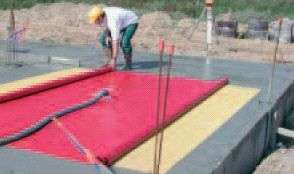
Fresh concrete contains a continuous system of water filled channels. The application of a vacuum to the surface will result in a large quantity of water being extracted from the close, say 100mm depth, surface. The process was invented and patented in 1935 by K P Bilner.
When concreting in cold weather, heated concrete has a ‘flying start’ in the race for early strength, provided that the heat is retained. Either the aggregates or the water (or both) can be heated. Steam lances or steam coils can be used to heat aggregates and steam coils to heat the mixing water.